
The AI coding agent that
ships production code,
not textbook answers
Elith reads your prompt, understands the intent, spins up the right swarm of specialized agents — devops, dev, qa — and orchestrates them until the codebase is genuinely production-ready. Every model. Any repo. One framework.
$ elith "harden checkout for black friday traffic"
→ intent parsed: scale + reliability
→ spawning agents:
[devops] capacity & infra review
[dev] refactor hot path, add idempotency
[qa] load tests + chaos scenarios
→ context engine: loaded 7 files from 412
→ proposing architecture: CQRS read replicas + queue backpressure
✓ pipeline ready: devops → dev → qa → devops → prod
// preview
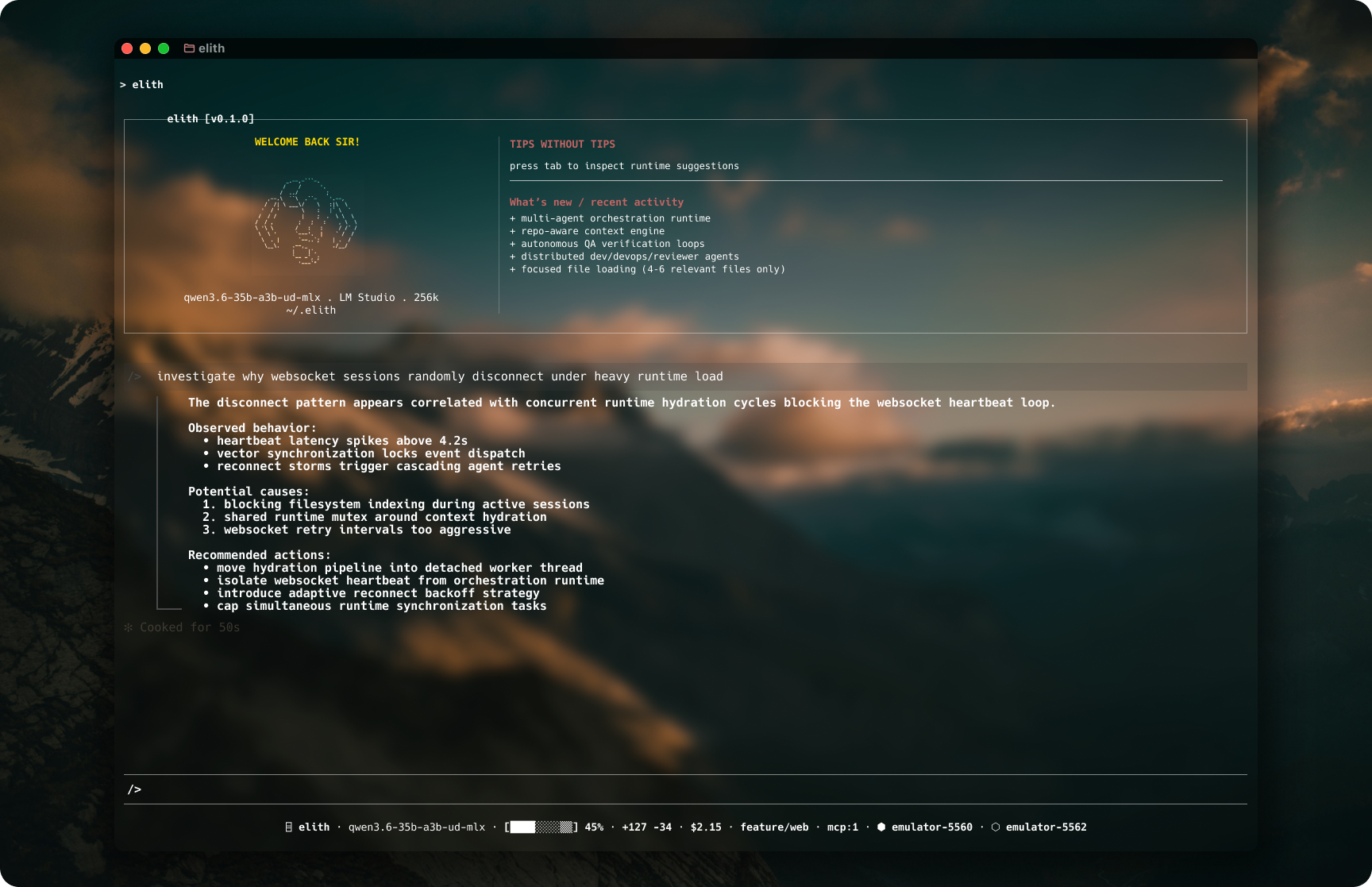
See it in action
The Elith TUI — agents, runtime diagnostics, and context loaded into a single keyboard-driven workspace.
// the problem
§ 01 — why ai-assisted dev still failsTextbook answers
Ask any LLM to architect a system — you get a generic MVC/REST diagram. Never a hybrid CQRS because your read:write is 20:1. Never a strangler fig because you can't stop the business.
Repo-blind models
Claude, Gemini, GPT are powerful reasoners — but they can't read your files, run your tests, or commit changes. You paste, they guess, you copy back. Context bloats. Quality drops.
Single-agent ceilings
One model trying to do dev, qa and devops simultaneously will mediocre at all three. Real shipping requires specialists handing off work — not one generalist juggling roles.
// the pipeline
§ 02 — prompt to production, no humans in the loopElith doesn't generate code — it orchestrates a team. Each agent owns a phase of delivery. They hand off, review each other's output, and loop until the work actually meets a production bar.
   ┌──────────┐   ┌──────────┐   ┌──────────┐   ┌──────────┐
   │  PROMPT  │──▶│  INTENT  │──▶│  AGENTS  │──▶│  ROUTER  │
   │  parser  │   │ analysis │   │  spawn   │   │ pipeline │
   └──────────┘   └──────────┘   └────┬─────┘   └────┬─────┘
                                      │              │
        ┌─────────────────────────────┴──────────────┘
        ▼            ▼            ▼            ▼
   ┌─────────┐  ┌─────────┐  ┌─────────┐  ┌─────────┐
   │ DEVOPS  │◀▶│   DEV   │◀▶│   QA    │◀▶│  PROD   │
   │ scaffold│  │ implement│ │ verify  │  │ deploy  │
   └─────────┘  └─────────┘  └─────────┘  └─────────┘
                     ▲            │
                     └── loop ◀───┘   (qa fails → back to dev)
// the swarm
§ 03 — specialists, not generalists[Devops]
- ▸scaffold infra
- ▸ci/cd pipelines
- ▸secrets & env
- ▸containerize
[Architect]
- ▸read full repo
- ▸propose 2-3 designs
- ▸tradeoff analysis
- ▸migration path
[Dev]
- ▸implement modules
- ▸follow repo patterns
- ▸wire integrations
- ▸open PRs
[QA]
- ▸generate tests
- ▸run suite
- ▸chaos & load
- ▸report regressions
[Reviewer]
- ▸read diff
- ▸flag risk
- ▸enforce standards
- ▸summarize change
[Docs]
- ▸update readme
- ▸write adrs
- ▸api references
- ▸changelogs
// every model
§ 04 — bring your own brainPick the model you trust. Elith's skill layer gives each one the same repo awareness — read files, search code, run tests, commit changes — through agent tool calling. No paste-and-pray.
// textbook vs elith
§ 06 — same question, different answers// install
§ 05 — one command, any package manager$ curl -fsSL https://elith.silohq.tech/install.sh | sh